
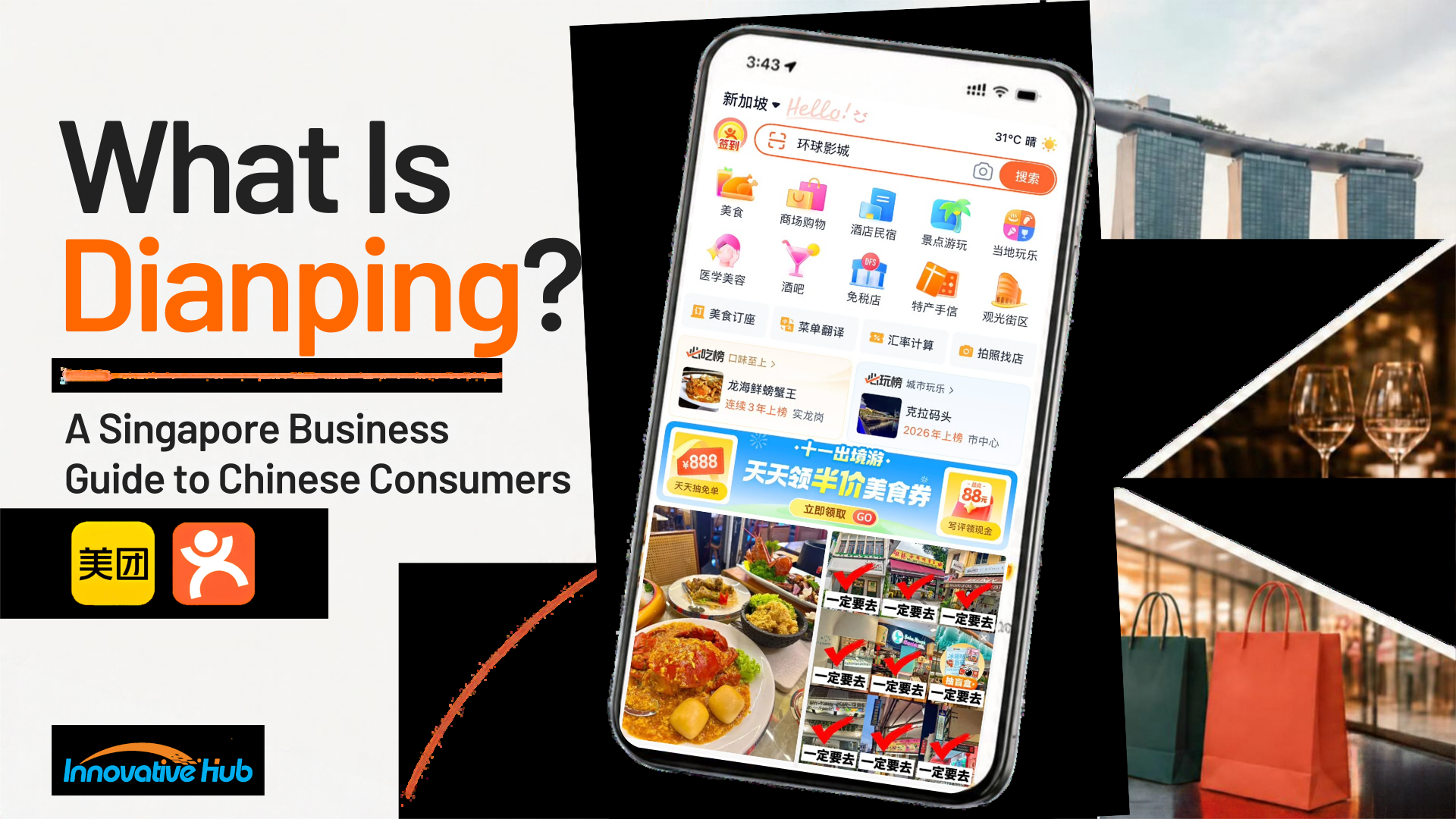
What is Dianping? For millions of Chinese travellers, it answers a more practical question: where should I eat, shop, and spend in Singapore? Often called “the Yelp of China,” Dianping (大众点评, Dàzhòng Diǎnpíng) is China’s dominant Chinese review platform — but that label undersells it. It’s the discovery and reviews layer of the Meituan super-app (Meituan Dianping), and it’s where the decision gets made. In 2025, China was Singapore’s number-one tourism source market, sending 3.1 million visitors. Nearly all of them research on Dianping before they land — not on Google, TripAdvisor, or a business’s own website.
This guide covers what Dianping is, how it works, how Chinese travellers use it to decide, how Singapore businesses get listed and marketed on it, and where it fits alongside Xiaohongshu in a 2026 China-consumer strategy.
What Is Dianping?
China’s Local-Review Super-App, Explained
Dianping (大众点评) was founded in Shanghai in 2003 as a restaurant review site. Two decades later it sits inside Meituan — the Fortune 500 super-app that handles food delivery, hotel booking, and local services for hundreds of millions of Chinese users every month. Dianping is Meituan’s discovery and reviews layer: the place people go before they buy.
The comparison most Western operators reach for is “the Chinese Yelp,” and that’s directionally right but understates it. A single Dianping listing bundles together:
- User reviews with photo and video content (comparable to Yelp)
- Map-based local search, including outside mainland China (comparable to Google Maps)
- Reservation and pre-order flows (comparable to OpenTable)
- Coupons, group deals, and merchant-run promotions (no direct Western equivalent)
- KOL and KOC (影响者 / 素人) content woven into the store page itself
The unit of the platform is the shop page (店铺), not the ad. A Chinese user searching “新加坡 海鲜” (Singapore seafood) lands on shop pages ranked by reviews, photos, distance, and content freshness — not on paid interstitials.
Why Dianping Matters for Singapore Businesses
The Singapore stakes are real. In 2025, Singapore welcomed 3.1 million visitors from Mainland China, making it the country’s largest source market by visitor arrivals out of 16.9 million international arrivals overall. Chinese visitors arrive with their phones already open — and the app they open first is rarely Google. It’s Dianping. For F&B, retail, aesthetics, and hospitality operators in tourist zones or targeting Chinese-speaking residents, being invisible on Dianping means being invisible to a demonstrated multi-million-visitor source market with real spend intent.
Two further points matter for reaching Chinese consumers in Singapore:
- It isn’t only tourism. A large share of Singapore’s Chinese-speaking residents (PR holders, EP holders, locally-born Mandarin speakers) also default to Dianping for Chinese-language reviews.
- The window is now. Chinese outbound travel to Southeast Asia has been rebuilding through 2025 into 2026. Businesses already indexed, reviewed, and ranking capture the clearest upside — not those setting up after the wave arrives.
How Chinese Tourists Discover Singapore Businesses
Discover
A user searches by category, location, or occasion — “新加坡 甜品” (Singapore desserts), “新加坡 亲子” (family-friendly), “圣淘沙 高档餐厅” (Sentosa fine dining). Dianping surfaces shop pages ranked by review freshness, photo density, distance, and rating. Meituan-Dianping’s international materials list Orchard Road, Marina Bay, Sentosa, Chinatown, Bugis, Clarke Quay, Geylang, Changi Airport, NUS, and Novena among the most-searched Singapore areas.
Compare
Users tap through 3–7 candidate listings, cross-referencing ratings (food / environment / service), price band, dish photos, and review quotes. Listing completeness matters most here — a sparse listing loses to a photo-dense competitor even at a similar rating.
Evaluate
Users read long-form reviews, frequently 300+ Chinese characters with 10+ photos. This is where trust is built or lost. Recent, detailed reviews — especially from high-credibility users — outperform older, sparse content.
Decide
Users bookmark, save, or navigate to the location. Merchants with reservation flows, coupons, or group-buying offers capture more decision-stage conversions. The store page a traveller sees in Shanghai on Tuesday is the same one they navigate to in Chinatown on Saturday.
The key point: at every stage, the algorithm rewards activity. A listing dormant for 60+ days loses ranking to newer, more active competitors — even one with more lifetime reviews.
How Does Dianping Work? :Reviews, Ratings and O2O Bookings
Under the hood, how Dianping works comes down to three linked mechanics:
- Reviews & ratings. Each shop page carries a star rating split across food / environment / service, plus written reviews and user photos. Ranking weights recency and richness — fresh, photo-heavy reviews lift a page faster than a high lifetime score with stale content.
- Search & ranking. Results are ordered by a mix of relevance (category + keyword), proximity, rating, and content freshness. This is why an active, well-tagged listing beats a dormant one.
- O2O (online-to-offline). Dianping closes the loop from discovery to purchase — coupons, group-buy deals, reservations, and navigation — so a review view can convert directly into an in-store visit or booking.
How to Attract Chinese Travellers: What Makes a Strong Dianping Listing
If you want to attract Chinese travellers to your Singapore business, the listing itself does most of the work. A well-maintained overseas shop page shares a consistent set of features:
- Bilingual name (English + simplified Chinese)
- Address formatted for Chinese users — MRT reference points, not just postal codes
- Merchant-uploaded photography, not just reviewer photos — portrait orientation, tighter framing, more product/dish close-ups than Western guides use
- Signature dishes or hero SKUs tagged with individual photos and prices
- Opening hours in Singapore time
- A short Chinese-language description above the fold
- The correct category claimed (F&B / retail / beauty / hotel / attraction)
The single strongest predictor of ranking is freshness of reviews. Listings with reviews from the last 60 days outrank listings with higher lifetime scores but older content. That’s why merchants who build a small, ongoing review pipeline — QR codes at the till, Chinese-language thank-you cards, occasional light incentives — compound faster than those who treat Dianping as a one-time listing exercise.
How Singapore Businesses Get Listed on Dianping
Getting a Singapore business onto Dianping is more accessible than most owners assume — the basic listing itself is free, and you don’t need a mainland Chinese business license. Here’s how it actually works:
- A basic listing is free to claim. Overseas merchants register or claim a basic profile through Dianping’s overseas-merchant portal (境外商家中心) using their Singapore business details — no China license required, no fee just to appear.
- What you supply: a bilingual (English + Chinese) business name, your SG registration details, the correct category, address with nearby MRT/landmarks, opening hours, and a first set of merchant photos.
- The paid parts are optional and come later — not the listing. They’re growth tools you opt into: the merchant management subscription (商户通, an annual fee), platform commission on group-buy/transactions (佣金), and paid promotion (推广通). You use these to boost visibility and sales, not to exist on the platform.
- The real ongoing investment is content, not access. Budget for Chinese-language copy, photography, and a steady review pipeline — that’s what actually moves ranking.
Some operators handle this in-house with a Mandarin-capable marketing hire; others route it through a partner with a direct Dianping relationship who manages the profile, content and paid tools end-to-end
Meituan Dianping Marketing :Coupons, KOCs and Location Ads
Beyond the organic listing, Meituan Dianping marketing gives merchants a paid toolkit to amplify reach at the decision stage:
- Coupons & group-buy deals — the classic O2O lever; a limited-time voucher on the shop page converts browsers into walk-ins.
- KOC / V-达人 content — verified reviewers and everyday micro-creators produce the photo-rich reviews that power discovery; seeding a handful early gives a new listing credibility.
- Location-based promotion — paid placement surfaces your shop page to nearby, in-market users searching your category.
Pinyin glossary (useful when talking to the platform or an agency):
- 推广通 (Tuīguǎngtōng) — Dianping’s promotion / paid-ads product
- 商户通 (Shānghùtōng) — the merchant portal for managing your listing
- V达人 (V-dárén) — verified/influential reviewers whose content carries extra weight
Dianping vs Xiaohongshu: Where Each Fits
Dianping isn’t the only Chinese-facing channel that matters. Understanding where it fits alongside the other two dominant platforms sharpens the strategy decision — and “Dianping vs Xiaohongshu” is the comparison operators ask most.
| Platform | Role in the journey | What it does best | Best for |
| Xiaohongshu (小红书) | Discovery / inspiration (upstream of intent) | Builds category consideration through KOC content and lifestyle posts — shapes what a traveller wants to do | Awareness, aspiration, trip pre-planning |
| Dianping (大众点评) | Decision (the moment of choice) | Reviews, ratings, photos, coupons and bookings — decides where they actually go | In-market discovery & conversion |
Read across: Xiaohongshu shapes what a traveller wants to do, Dianping decides where they do it. For a Singapore F&B or retail operator planning a 2026 China-consumer strategy, the strongest combination is Xiaohongshu + Dianping — XHS builds consideration through KOC content; Dianping captures the decision-stage search. WeChat becomes relevant later, once a retention loop matters.
Common Misconceptions About Dianping
“It’s only for restaurants.” F&B is Dianping’s origin category and still its largest, but the platform now indexes retail, beauty, wellness, entertainment, hotels, and attractions across 400+ categories. Any business a Chinese traveller chooses between options for can live on it.
“Our TripAdvisor / Google reviews already cover this.” Chinese travellers, particularly first-time visitors, largely don’t use either — because of language, app ecosystem, and content format, not preference. A perfect 5-star TripAdvisor page is invisible to a Chinese-language search.
“It’s only for big brands.” Often the opposite. Small independents perform disproportionately well because the platform rewards specificity, review quality, and photo density — not ad spend. A well-run 30-seat restaurant with fresh Chinese-language reviews can outrank a chain with a stale listing.
Which Singapore Businesses Benefit Most?
Dianping is category-agnostic in principle, but a few segments see clearer returns:
- F&B — restaurants, cafés, dessert shops, bubble tea, hawker chains. Highest overseas search-volume category.
- Retail — gifts, souvenirs, fashion, jewellery, luxury. Chinese travellers pre-plan retail itineraries the way they pre-plan dining.
- Beauty & wellness — aesthetics clinics, massage, hair salons, nail bars. Chinese-speaking residents drive much of this alongside tourists.
- Hotels & serviced apartments — complements Booking.com / Ctrip presence, especially for boutique properties.
- Attractions & experiences — museums, tours, workshops, escape rooms. Growing as Chinese travel shifts from group tours to experiential.
If your business is in a tourist-heavy zone, currently attracts (or wants to attract) Chinese-speaking customers, or is missing from Chinese-language search results for your category, Dianping is worth serious evaluation.
Is Dianping Right for Your Business?
Answer these honestly:
- Are you in a tourist-heavy zone (Marina Bay, Orchard, Chinatown, Sentosa, Bugis) — or otherwise attracting Chinese-speaking customers?
- Are your current channels (Google, TripAdvisor, Instagram) missing an obvious Chinese-language layer?
- Is a direct competitor already on Dianping, accumulating reviews you’re not seeing?
- Do peak Chinese tourist windows (Chinese New Year, Golden Week, June school holidays, year-end) materially affect your revenue?
If two or more are “yes”, Dianping presence is structural to your discovery layer — not optional.
Reach Chinese Consumers in Singapore With the Right Platform Mix
Innovative Hub is an IMDA SMEs Go Digital Pre-Approved Solution provider, with official partnerships across Alibaba, Xiaohongshu, TikTok Shop, and Dianping. We run Dianping listings and Xiaohongshu KOL/KOC campaigns for Singapore F&B and retail brands across the tourist zones — from listing setup and Chinese-language content to review pipelines and reporting. If you’re weighing up a Dianping marketing agency in Singapore or a Xiaohongshu KOL agency in Singapore, we can help you scope both.
Book a free 15-minute fit assessment — or explore our Dianping marketing service and Xiaohongshu KOL service.
 enquiry@innovativehub.com.sg
FAQs
1. What is Dianping and how does it work?
Dianping (大众点评) is China’s largest local-reviews and discovery platform, part of the Meituan super-app. Chinese consumers use it to find and choose restaurants, shops, and services — including overseas — by comparing reviews, photos, ratings, and location, then booking or navigating directly from the shop page.
2. How can a Singapore business get listed on Dianping?
Getting listed is free — you claim a basic profile through Dianping’s overseas-merchant portal (境外商家中心), no mainland Chinese licence needed. You provide a bilingual name, your Singapore business details, category, address, and photos. The paid parts are optional growth add-ons (merchant subscription 商户通, transaction commission, and paid promotion 推广通), and many businesses use an authorized partner to run the Chinese-language content and review pipeline that actually drives ranking.
3. What is the difference between Dianping and Xiaohongshu?
Xiaohongshu is discovery and inspiration — it shapes what a traveller wants to do before the trip. Dianping is the decision moment — where they compare reviews and choose where to eat, shop, or book. Most effective 2026 strategies pair the two rather than choosing one.
4. Is Dianping worth it for a Singapore restaurant or retail store?
If you’re in a tourist zone or serve Chinese-speaking residents, usually yes. Chinese travellers research on Dianping, not Google or TripAdvisor, so a complete, well-reviewed listing captures demand competitors on Western platforms simply can’t see. Returns depend on keeping the listing active.
5. Do I need a Chinese business licence to sign up on Dianping?
No. Singapore businesses register through Dianping’s overseas-merchant route using their Singapore business details, typically via an authorised onboarding partner — you don’t need a mainland China business licence. The main requirements are a verified listing, correct category, and Chinese-language content.
6. How much does Dianping marketing cost for foreign businesses?
There’s a paid onboarding fee that varies by category, but the larger ongoing investment is content and review management — Chinese-language copy, photography, and a steady review pipeline. Budget for the programme, not just the listing. We can scope a specific quote for your category.
About the author
Written by the Innovative Hub team — an IMDA SMEs Go Digital Pre-Approved Solution provider and official partner of Alibaba, Xiaohongshu, TikTok Shop, and Dianping, helping Singapore businesses reach Chinese consumers since 2016.
Last updated: 25 Sep 2026